
How to Choose the Right Size Boiler for Your Denver Property
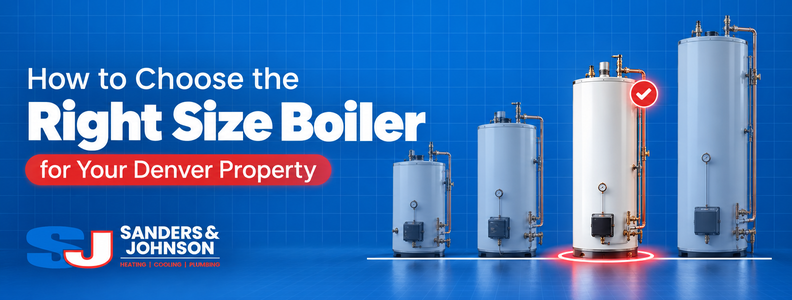
Choosing the right boiler for your Denver property starts with a professional heat load calculation. Professionals use this calculation to determine the correct boiler size required to keep your home comfortable on a cold winter night.
Denver homes also have factors other homeowners don’t have to consider, like high altitude and wide winter temperature swings. A boiler that’s too large will turn on and off too often and waste gas, while one that’s too small won’t be able to keep your home warm when nighttime temperatures dip into the single digits. This guide explains how to pick the right size boiler and what to look for when replacing your heating system.
Quick Answers
- Boiler size is measured in BTUs, which show how much heat a boiler can deliver each hour.
- A professional heat loss calculation is the best way to size a boiler for your home.
- Denver homeowners need to account for the high altitude when sizing a gas boiler, since thinner air lowers its heat output.
- When comparing boilers, the output rating, efficiency, modulation, and radiator type all affect which is the right fit for your home.
- Sanders & Johnson provides professional boiler sizing and installation for homes across Denver and surrounding communities.
Why It’s Important to Correctly Size a Boiler
Correctly sizing a boiler system is important because it affects how warm your home stays and how much you pay to heat it. A boiler that matches your home’s heat loss runs efficiently and keeps rooms at an even temperature, so you stay comfortable without paying for gas you don’t need.
A correctly sized boiler also puts less strain on its components. When you install a boiler that runs steadily and completes full cycles, parts like the ignitor and circulator pump wear out more slowly and need fewer repairs or replacements.
What happens if your boiler is undersized or oversized
An undersized boiler can’t make enough heat to keep your home warm when Denver temperatures drop below freezing. During cold snaps, an undersized boiler has to run constantly to keep up, but it still can’t bring your rooms up to the set temperature.
A few signs your boiler may be undersized include:
- Rooms that never reach the temperature on your thermostat.
- A boiler that runs for hours at a time without shutting off.
- Radiators or baseboards that feel warm instead of hot.
- Needing space heaters in some rooms every winter.
An oversized boiler heats your home’s water too quickly and shuts off before it finishes a full cycle. It might turn on and off multiple times within an hour, using more gas to reheat the water each time and wearing out components like the ignitor and gas valve faster.
Your boiler may be oversized if:
- It turns on and off every few minutes.
- Your gas bills seem high for the size of your home.
- Some rooms swing between too warm and too cool.
Oversized boilers are more common than undersized ones in Denver homes. Many older homes have large boilers installed decades ago, like cast-iron Weil-McLain or Burnham models, and owners have since added insulation and replaced windows that now hold more heat inside and don’t need such a large system.
What Size Boiler Do I Need for My House?
The size of the boiler you need for your house depends on how much heat your home loses on an average cold winter day. Technicians can find this number by doing a heat load calculation for each room in your home.
A heat load calculation factors in:
- The square footage and ceiling height of each room.
- How much insulation is in your walls, attic, and floors.
- The number, size, and condition of your windows and doors.
- How much outside air leaks into your home.
- The type of radiators, baseboard heaters, or in-floor heating you have.
Understanding Boiler Sizes for Your Denver Home
Boiler sizes are measured in British Thermal Units (BTUs), which show how much heat a boiler can deliver to your home each hour. For Denver homes, the right BTU size comes from your heat load calculation plus an adjustment for altitude. Today’s modern boiler manufacturers offer modulating equipment that can adjust heating output up or down as needed.
Once you know the right BTU size for your home, you can compare boilers by their efficiency and features. Here are a few things to look at:
- Output rating: Check the BTU output, which is the heat that actually reaches your home.
- Efficiency: High-efficiency boilers like Lochinvar turn more of their gas into heat than standard-efficiency models like Weil-McLain.
- Modulation: A modulating boiler can raise or lower its flame to match how much heat your home needs.
- Radiator type: Older cast-iron radiators often need hotter water, which can affect how efficiently a high-efficiency boiler runs in your home.
Choosing the right boiler for Denver’s weather
Many homeowners opt for modulating boilers to handle Denver’s weather. They adjust their flame to fit the conditions, so a sunny day and freezing night both get the right amount of heat. Many Lochinvar and Laars boilers modulate, and matching heat output to the weather helps avoid short cycling during the Front Range winters and cuts down on wasted gas.
Location also comes into play when choosing a boiler size. Homes in areas like Evergreen or Conifer have colder nights and larger altitude adjustments, so they need a different size than a similar home in central Denver.
Schedule a Boiler Sizing Consultation with Sanders & Johnson
At Sanders & Johnson, we’re your local boiler experts. We’ve helped Colorado homeowners choose the right boiler size for 49 years, and our team of experienced boiler technicians knows how to size systems for Denver’s altitude and temperature swings. We’ll measure your home, complete a full heat load calculation, and walk you through the numbers in plain language so you understand why a certain size fits your home.
Contact our team today to schedule your boiler sizing consultation and find the right boiler for your home. We also offer financing options to help your heating installation or replacement fit into your budget.
Frequently Asked Questions
Should I replace my boiler with the same size?
Replacing your boiler with the same size isn’t always the right choice. If you’ve added insulation, replaced windows, finished a basement, or built an addition, your home’s heating needs have changed. A new heat load calculation will show you what size your home needs now.
How long does a boiler last in Colorado?
Boilers last between 25 and 35 years in most Colorado homes. Annual maintenance helps your unit reach the longer end of that range. Most manufacturers also require yearly maintenance by a qualified technician to keep your warranty valid.
How does elevation affect boiler sizing?
Denver’s altitude lowers the amount of heat a gas boiler puts out. At 5,280 feet, there’s less oxygen in the air, so a boiler burns gas less effectively than it would at sea level. Your installer can make high-altitude adjustments to account for this drop.